
Your Role in Responsible Alcohol Service
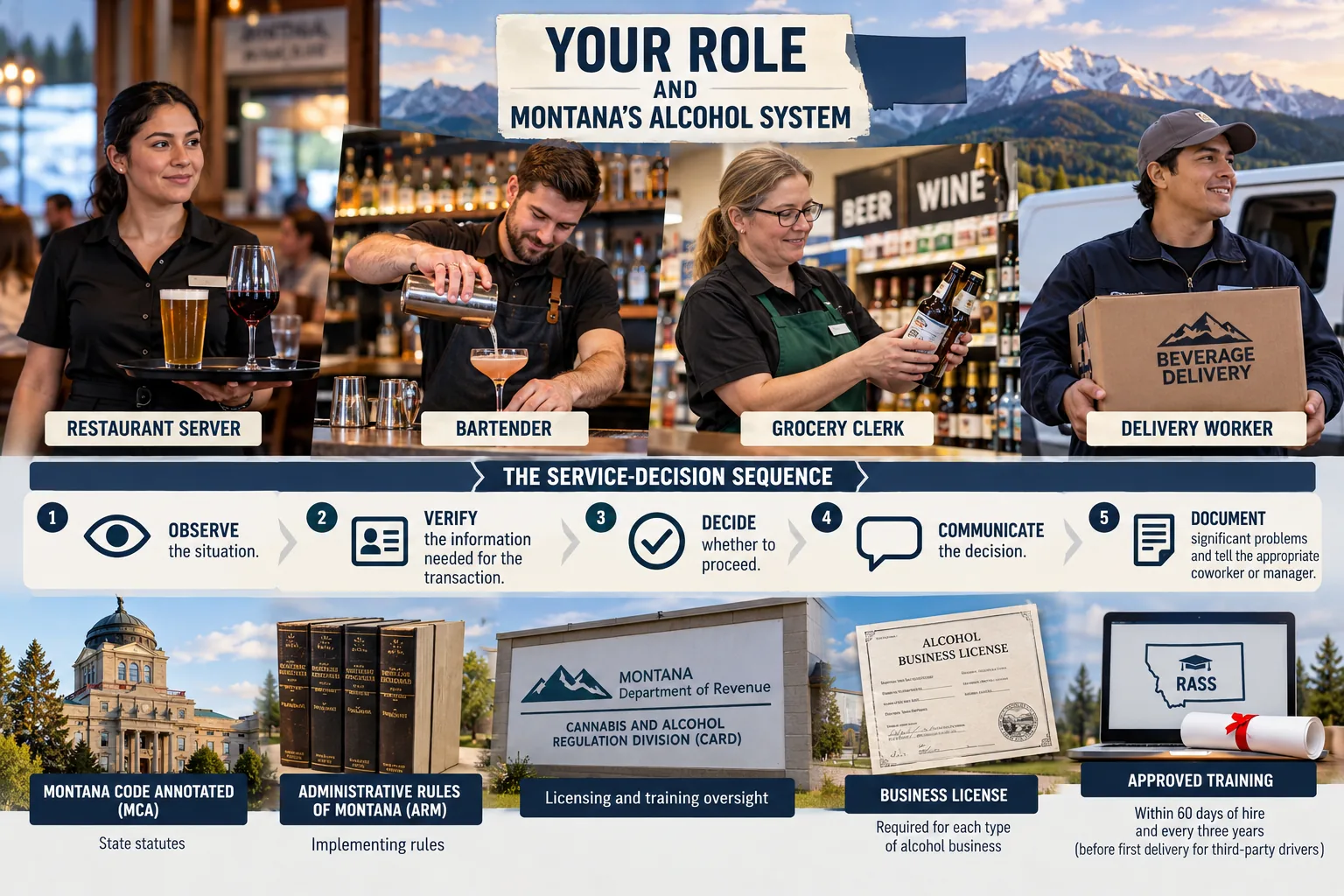
Your Role in Responsible Alcohol Service
Whether you serve drinks at a table, work behind a bar, sell packaged beer, or make an approved delivery, each alcohol transaction needs a careful decision.
You are part of the safety team
Alcohol service is more than taking an order or scanning a package. Your job is to notice the situation, check who will receive the alcohol, and decide whether it is okay to continue. You can be friendly and still say no.
A refusal should not humiliate a customer. You do not have to diagnose a condition, prove someone committed a crime, or win an argument. You do need to explain the decision calmly, call for backup when needed, and act if someone is in danger.
A simple service routine
Observe → Verify → Decide → Explain → Document. Use this same sequence with regular customers, large groups, and people who are in a hurry.
Different jobs, same responsibility
- Restaurant server: Verify the actual drink recipient, not just the person paying the bill.
- Bartender: Watch for changes in behavior before another round.
- Store cashier: A sealed package still requires a lawful sale.
- Delivery worker: A paid online order still needs the required age and safety check at the door.
Your workplace may have stricter procedures. Know them before your shift. If you do not know the next step, pause the alcohol transaction and ask the person responsible for alcohol operations.
Why licenses matter in Montana
Montana has regulated alcohol distribution and sales since the end of national Prohibition in 1933. Different business licenses allow different products and types of service. A restaurant license, brewery sample-room privilege, store license, and delivery authorization are not interchangeable.
A business must follow its actual license, local restrictions, and applicable law. A training certificate does not add a new delivery service, give permission to sell a restricted product, or make an employee eligible for every alcohol-related job.
The state alcohol-regulation agency approves training and oversees licensing. You do not need to memorize government office names during a customer transaction. You do need to know your workplace’s written rules and who can answer a licensing question.
Training and worker age
Montana sellers and servers, and their direct supervisors, generally must complete approved training within 60 days of hire and renew it every three years. Existing workers at a newly licensed business generally have 60 days after licensure.
Third-party delivery drivers have stricter timing: qualifying training must be completed before their first alcohol delivery. Third-party delivery drivers must be at least 21. Montana also has an age-18 rule for specified bartender and alcohol-server duties; different packaged-retail work requires the employer to check the child-labor rules that apply to that job.
Employers keep training records. Only the approved course scope and actual completed requirements determine whether a certificate is valid for your duties.
Start-of-shift situations
At a restaurant — See the worked example
A new server is assigned tables but does not know whom to call about a questionable alcohol order.
Why this works: Before serving, find the on-duty manager, backup contact, ID-check procedure, and method for recording a refusal.
At a grocery — See the worked example
A cashier asks whether training allows the store to deliver beer to any address.
Why this works: No. The business must have the proper delivery authority, and drivers, products, locations, and handoff rules must be checked separately.
When the customer is impatient — See the worked example
A guest says, “You checked me last month. Just bring the drink.”
Why this works: Continue the required check for this transaction under your workplace policy. Familiarity does not replace a lawful decision.
Remember These Key Points
- Every alcohol transaction is a safety decision.
- Different licenses and job duties have different rules.
- Know your manager, emergency procedure, and training responsibilities.
Ready to check your understanding?
Answer five questions together on the next page. Knowledge-check time is separate and does not count toward your 120 required instructional minutes.
The five-question check is available in an enrolled learner session.